
2026-10-06 ·
Water Heater Repair or Replacement in Fort Collins?
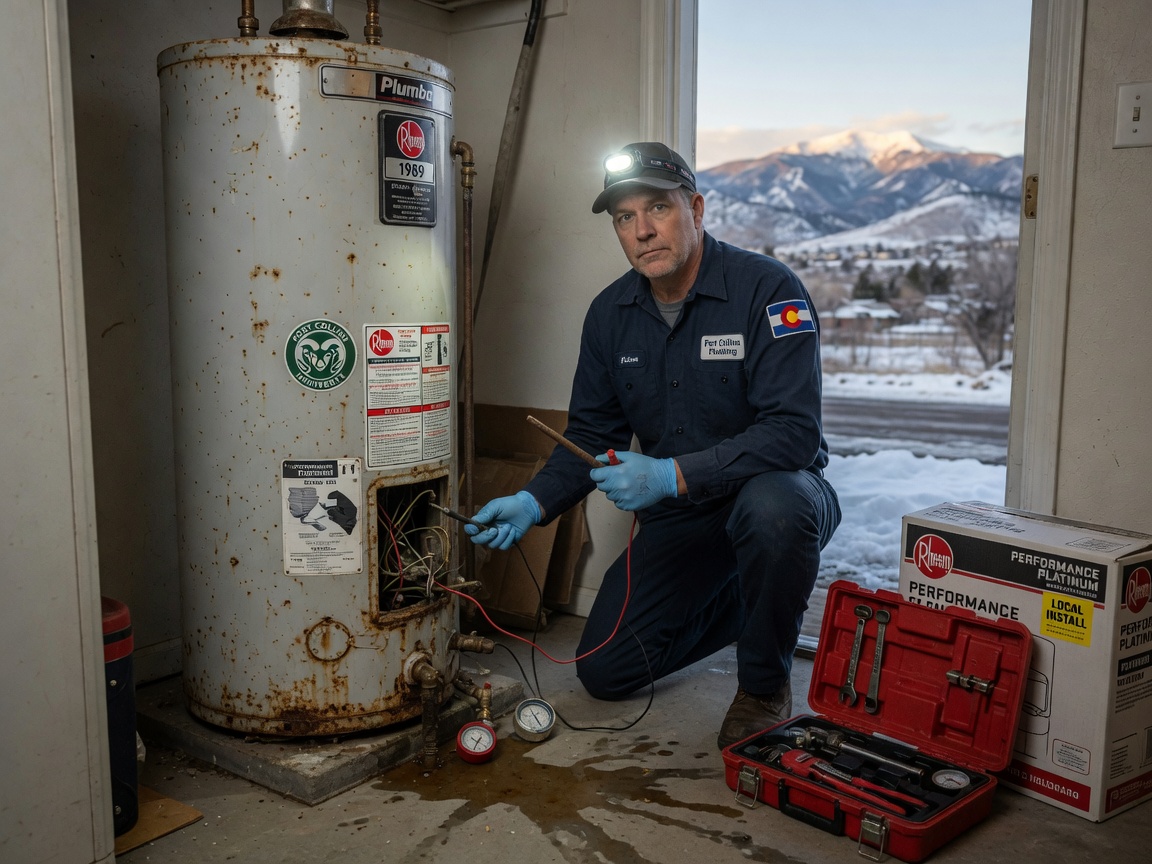
When your water heater acts up, the first question is usually whether it can be fixed or whether it is time for a new one. The honest answer depends on what failed, how old the tank is and what hard water has done to it over the years. Here is how we work through that decision with homeowners in Fort Collins.
Start with what actually failed. Many water heater problems come from parts, not the tank. On a gas heater that might be a thermocouple, pilot assembly, gas valve or burner. On an electric heater it is often a heating element or thermostat. A dripping temperature and pressure relief valve or a leaking fitting at the top of the tank is also a part. If the tank itself is sound, replacing the failed part is usually the sensible move, and our water heater repair visits start by confirming which part is at fault.
A leaking tank is the line. If water is coming from the tank body or seeping from the bottom seam, the steel has corroded through. There is no lasting repair for that. Shut off the cold supply valve on top of the heater, turn off the gas or power, and plan on replacement. If water is spreading across the floor, our emergency plumbing guide covers the first steps.
Age matters, but it is not the whole story. Most tank heaters are designed for roughly a decade or so of service, and hard water in the Fort Collins area tends to wear them faster. A heater past that point with a failed part may still be worth fixing if the tank is in good shape, but it is worth asking whether the money is better spent on a new unit. Check the label for the manufacture date before you call.
Sediment and the anode rod tell you a lot. Popping and rumbling noises mean sediment has built up on the bottom of the tank. The anode rod, a sacrificial metal rod inside, protects the steel from corrosion until it is used up. When we drain a tank and find heavy scale, or pull an anode that is gone, that tank has less life left than its age suggests. If the anode is worn but the tank is still sound, replacing it and flushing the sediment can buy years.
Think about how you use hot water. If you run out of hot water more often than you used to, the cause may be sediment, a failed lower element or a dip tube problem, all of which can be repaired. If your household has grown, the tank may simply be too small, and that is a reason to replace rather than repair. That is also the moment to consider a tankless unit, which needs the right gas supply and venting route but provides hot water on demand.
Installation details matter in Fort Collins homes. Gas heaters at our elevation need correct combustion air and venting. Older basements near Old Town often have tight utility closets that limit size and venting options, while newer homes in Timnath, Windsor and Johnstown may have room for a tankless conversion. Replacement usually involves a permit, and we check expansion tank, relief piping and venting rather than simply swapping one tank for another.
A quick way to decide. Repair if a part failed, the tank is not leaking and the heater still meets your household's needs. Replace if the tank is leaking, heavily corroded or past its expected life with repeated failures, or if your hot water demand has outgrown it. For more on why heaters here wear early, read our guide to hard water and sediment in Fort Collins water heaters.
If you are not sure which side of the line your heater is on, call Plumbers Fort Collins at (970) 447-1519. We will diagnose it, explain whether repair or replacement makes more sense and put the scope in writing before any work starts. We serve Fort Collins along with Wellington, Laporte, Berthoud and Severance.